Wednesday, August 31, 2011

Texas Book Festival

I didn’t think I’d be posting about the Texas Book Festival this year (October 22-23), unless it was an “after-party” post about events I went to see. For years now, I’ve been the Chair of the events going on at the Austin Museum of Art. At that venue, we hosted a lot of art, architecture, and photography books and authors. But since the 2010 TBF, the Austin Museum of Art (AMOA) moved out of the downtown area, so we lost it as a venue.

That meant I no longer had a Chair position. As it turns out, TBF needed a third person to help chair the Author Escorts committee, so I’m back working. While AMOA was a one-person chair that needed around 20 or 25 volunteers over the weekend, Author Escorts needs three chairs, well over a hundred volunteers and one night of pre-training.

The good news is that those volunteers are the ones who “herd” authors, some local, some national. (The complete listing of this year’s authors is not up, but the lineup for the 2011 Gala can be found, starting on the home page.) They escort them to their event venue. When their talk is over, they escort them to the book signing tent. They make sure the author gets where he or she needs to go, has everything he needs, including nametag and water or coffee, and she doesn’t arrive late because she stopped to talk to another author and lost track of time. The volunteers get to meet and talk to authors, be they best-selling politicians or first-time authors.

Doesn’t that sound like a cool volunteer opportunity? If it does, you can go to the Texas Book Festival site and sign up for a shift or two. If you do, be sure you yell “hi” to me!

Saturday, August 27, 2011

You Won’t Want to Read This, but Do

I came across a long article by Ewan Morrison in The Guardian, which asked the question: Are books dead, and can authors survive? The more I read, the more I didn’t want to keep reading. But I did. Morrison paints a very dark picture for writers, in my opinion.

He starts off by saying that within 25 years “the digital revolution will bring about the end of paper books.”

He follows that by adding that “ebooks and e-publishing will mean the end of "the writer" as a profession.”

Big sites like Amazon and Google aren’t looking for unique content from authors to make money. They’re looking for content that will draw advertisers, which is where they make their money. And that free content can come from old books no longer under copyright; from free e-books; from groups that steal content, repackage it and sell it under multiple names or even give it away; from people who plan to make money not on the book but on what they gain on the side.

He ends the article with this sentence:
I ask you to leave this place troubled, and to ask yourself and as many others as you can, what you can do if you truly value the work of the people formerly known as writers.

Thursday, August 25, 2011

What’s Your Expertise?

I read an article in CIO about a guy who had a start-up business called JibberJobber, a service for job seekers. He also had another idea – to write a book about using LinkedIn for job searching. Pretty soon, he had a publishing contract.

Zip forward five years. He’s sold 12,000 copies and earned just under $100,000. His company has “credibility” because of his book. He’s now considered an authority.

In the article, he goes on to tell readers how they, too, can do what he did.

Now, before you all zip over to read the article, leave a comment and tell us what kind of book you would write and about what? What expertise do you have that you could put in a book and re-make yourself as an expert who would be paid to speak at conferences and other venues? What would be your book’s title? Or, give us a one-line tease for your book.

Wednesday, August 24, 2011

BookStats

If you haven’t already read the report by the Association of American Publishers and Book Industry Study Group of BookStats, you’ll want to link over to an article in Publishers Weekly that talks about it.

Here are some of the more interesting, I thought, conclusions and stats.
Total estimated revenue for all publishers rose 3.1% in 2010, to $27.9 billion, following a 2.5% increase in 2009. E-book sales across all publishing categories rose 29.4% in 2009 and 38.9% in 2010, and accounted for 5.8% of total industry revenue in 2010.

Hardcover sales, after rising in 2009, fell 6.6% in 2010, the same pattern shown by trade paperback.

BookStats data show what other reports have found—retail stores losing ground to online e-tailers in the trade segment.

While online e-tailer's sales rose 88.8% between 2008 and 2010, it was actually mass merchandisers that had the strongest gains, with sales jumping 553.2%, to $218.5 million, an encouraging development for trade publishers … 
Check out the full article, which includes charts with a breakdown of categories, industry sales, trade sales by format, and trade sales by channel.

Is this bad news for print publishers? Is is good news for readers? 

Saturday, August 20, 2011

Should Publishers Fight Back?

An article in the Chicago Times says that book publishers should fight back against ads for eReaders. You’ve probably all seen that TV ad where the guy reading on the Kindle meets the girl heading to buy a print book, entices her to look at his Kindle and almost loses the Kindle to her when she begins to read and doesn’t want to stop.

Well, Aaron Gilbreath, the author of the article believes publishers should band together to come up with an ad that will be equally enticing, but will make people want to buy a print book and chuck their eReaders.
Why hasn't America's publishing industry launched an ad campaign as seductive and aggressive as the Kindle's? Not to market front-list titles or authors, but to market the paper book form itself? In other words, sell consumers on the exclusive pleasures and qualities traditional books offer that e-books cannot.

If traditional book publishers want to survive, then their marketing departments better think of a way. And fast.
Can print book publishers do that? Is it possible? Is it too late? What do you think? What kind of commercial would you script and shoot?

Thursday, August 18, 2011

I am a Freelance Editor

The title of today’s post sounds like I’m introducing myself at an AA meeting, doesn’t it?

Most of you probably already know I’m a freelance editor. And today I’ve donned my editor hat and headed over to literary publicist Stephanie Barko’s blog. I’m answering a couple of questions about editing and coaching. You’re all welcome to drop by and read my answers.

As an enticement for you to leave a comment or a question over at Stephanie’s blog, there’s a prize. One name will be drawn out of that ubiquitous hat for a free edit of the first 50 pages of your manuscript.

See you over there.

Wednesday, August 17, 2011

Book Review: City of Ashes

 Last month, I reviewed the first in the Immortal Instruments series, City of Bones. Today, I’m reviewing the second, called City of Ashes by Cassandra Clare.

Since this is a series, we’re back with the protagonist, Clary. She has some of the same cohorts, Simon, Jace, Luke, Magnus, plus some newer cohorts who play a bigger role than they did in the first book, Maia, Isabelle and Valentine.

Clary’s now a full-fledged demon-slayer. Her mother is in a magically-induced coma. Her father, Valentine, is intent on destroying the world, both the world you and I live in and the magical world. Clary’s in love with Jace, except she can’t be because he, it turns out, is her brother. Simon is in love with Clary, except, well, she’s not exactly human, except, well, there’s a big twist in the book, except, well, this is a paranormal/fantasy book so….

Anyway, everyone’s at war with someone. Valentine controls the demon world and will kill everyone, including family, if it means he gets his hands on the Immortal Instruments.

And there you go. City of Ashes has much more action than Book 1. It’s fast-moving with nary a dull moment. As with the first, it has a few too many characters to keep up with, but it was easier this time around since I knew the main players.

Clary has advanced in her skills as a Shadowhunter. I liked seeing her fight and stand toe-to-toe with the others. The alternate world that the faeries, vampires, werewolves, shadowhunters, and others live in is handled well in this book. I could see the differentiation and uniqueness of the various clans.

This book seemed to really focus on those main characters, instead of the “adults” in the two worlds.

The drawback for me was, as with Book 1, there’s so much going on that it’s a bit difficult to keep up. But then, I probably need to read more slowly. But that’s hard to do with the action is fast and often.

Amazon
 
Barnes & Noble

I admit that I’m well-past the target age of this series, which is probably around 16, but I’m still giving City of Ashes by Cassandra Clare a rating of Hel-of-a-Story.
~~~~~~~~~~~~~~~~~~~~
FTC Disclaimer: This book was loaned to me by an unknown girl who is a friend of my son who read all four books, but was not overly impressed, but then he’s not a teenage girl, so that’s logical. That, however, did not influence my review. I was influenced by the uptick in the action from the first book, and by Clary getting her armor on. She’s now a fighter and can get in the fray with the rest of her friends and hold her own. I like that in a female protagonist. Next time I find a tarantula in the garage, I’m gonna see if she’ll come get it and set it free in the woods.

Saturday, August 13, 2011

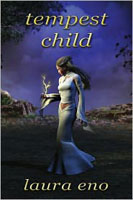
Book Review: Tempest Child

[For the sake of readability, I’m capitalizing the title of this book. In reality, it is all in lower case (tempest child).]

Tempest Child is the sixth book by Laura Eno. My guess is that the genre of this book is fantasy, but I would label it paranormal-romance-fantasy-kick butt. (Got your attention with the “kick butt,” didn’t I?)

Here’s the back cover blurb:
As future Queen and Guardian of the Elements, Princess Skylather’cha’eab thought her worst nightmare was the impending find-a-husband party until events take an ominous turn. Now she must put her life at risk to save her Kingdom.

Armed with only a staff, a bow, and her wits, Skyla’s world is turned upside-down when she enters the Crossroads and encounters the beast she’s destined to kill. Does she have the courage to sort truth from lie, or will she die not knowing who betrayed her?
Skyla is no shrinking violet. She’s been training all her life to fight for her kingdom. She’s been training to become Queen. At 17, she’s at the age when her father is about to marry her off. His idea of a husband is different from hers, but it’s not like she’s had time to find love on her own. All that goes by the wayside when the Kingdom is suddenly in danger and it’s up to Skyla to save it.

And that is where the kicking butt comes in.

It used to be that I read primarily mystery and thriller, not fantasy. Laura Eno has turned me into a fantasy reader. Her characters are multi-dimensional and different from each other (you won’t get them confused!) and her worlds are complex and well thought out. In Tempest Child there are five worlds, counting Skyla’s home. Each is totally different. Each is dangerous. Each could kill her.

I’ve read and reviewed two other books by Laura Eno: Don’t Fall Asleep and Prophecy Moon. I recommended both. And I recommend this one. I wouldn’t mind reading more adventures with Skyla.

Tempest Child - Amazon
Tempest Child - Barnes and Noble

I give Tempest Child by Laura Eno a rating of Hel-of-a-World because she’s created not one, but five, unique and interesting worlds.
~~~~~~~~~~
FTC Disclaimer: Tempest Child was sent to me by the author. This did not influence my review. I was influenced, though, by Eno’s mind. She takes us to five completely different worlds. To my way of thinking, creating one world would be difficult. Eno also created a perfectly imperfect character, who was not modeled after me. If she had been, Skyla would have missed her chance to go to the Crossroads because she would have been napping in her office. I mean … planning what weapons and supplies to take on the journey.

Thursday, August 11, 2011

Conferences

Today I’m posting a quick invite for you to join me over at The Blood-Red Pencil where I’m talking about conferences. Or more specifically, using conferences as a way to meet agents.

I worked at conferences when I was on the Board of Directors of the Writers League of Texas and ran the big Agents Conference while I was their Executive Director. I’ve also attended and led workshops at conferences. Conferences can be a good way to meet agents and see them as real people, not just as an unreachable goal. On the other hand, conferences are not the most effective way to hook up with agents.

Stop by and leave a comment or question. See you over there: The Blood-Red Pencil

And if you like this post and/or the one over at The Blood-Red Pencil, please click the blue Google +1 button at the bottom of the post.

Wednesday, August 10, 2011

Thinking Outside the Book

It used to be that books stayed the same. You could count on them, hold them, smell them. You bought them at a bookstore, where you also had the chance to hear the author speak. Not so much anymore.

But that doesn’t mean authors and companies aren’t thinking outside the book.

According to an article in Fast Company, Unbound has “crowd-financed” a book. The principle behind Unbound is “to take the ancient, leather-bound business model of book publishing, rip out its crumbling pages, and replace it with crowd-funding, social interaction, and tandem digital publications and real hardback books.”

Unbound proposes a book on its website. People can then choose to donate or fund the book. The more you donate, the more “access” to the author you get, such as a dinner with him/her.

I think this particular model would work best with authors who are already names, either as writers or some other form of celebrity.

But…in a way, it is similar to the rise of the Internet as a way to promote yourself. Because of blogs and other social media, readers now have greater access to writers they love, as well as new writers. Knowing a writer online means you’re more likely to buy their book.

Unbound is revving up the idea, but so are individual writers. Each time you connect with a reader via your tweets or posts or other online method, you, in a way, give that reader access to you. And as they get to know you, they’re more likely to buy your book, read your book, possibly review the book, and buy the next book.

So, if you’re thinking that all the time you spend online is a waste, think again. It pays to think outside the book.

Saturday, August 06, 2011

Print Books Not Lost

Are print books fast going the way of the dinosaurs? Maybe. But not as fast as some think. Recently, someone said there would be no more books printed within a year. I’m not buying that, especially after reading an article in the NewsLeader about an annual Rare Book School at the University of Virginia.

The picture at the top of the article shows young people, (not ancient readers like me, she who speaks of learning to read via printed words on paper) pulling a page from a replica of Ben Franklin’s Common Press.

Rare Book School has amassed a collection of 80,000 items “that range from 7th-century papyrus fragments to manuscripts stored on Reagan-era floppy disks and unreadable on the modern computer.”

The school offers 25 weeklong courses each summer. And they’re not just for young people. According to the article, the latest class “included a bookshop owner from Washington state, an English graduate student from New Zealand, a historian for the Mormon Church, a school librarian from Long Beach, Calif., and collegiate librarians from Oxford and Yale.”

The course sounds interesting to me:
In class, students take turns operating wooden and iron printing presses and hanging pages to dry. Or they gather round ancient manuscripts for a closer look at this goatskin binding or that woodblock rendering.
How about you? Does it sound interesting? Does it make you want to write a book that a hundred years from now people will hold in their hands and turn the delicate pages in awe?

Thursday, August 04, 2011

Book Review: An Uncommon Family

 An Uncommon Family by Christa Polkinhorn is the story of three people: Karla, a six year old girl, living with her aunt, Anna, and Jonas, an artist who comes to play a pivotal role in their lives. Primarily set in Zurich, Switzerland, the story also ventures to New York and Guadalajara, Mexico.

Here is the first paragraph of the cover blurb:
A chance meeting between a middle-aged woman, a widower, and a semi-orphaned child in the city of Zurich, Switzerland, brings together three people who grapple with a past of loss and betrayal. Six-year-old Karla, whose mother died in a car crash, has a hard time accepting the loss. Anna, her aunt and guardian, struggles with her former husband’s deception and her shattered confidence in men, and Jonas, artist and teacher, mourns the death of his wife.
The story is not nearly as “dark” as you might think by reading that blurb, although it does have its moments of tenseness and stress, misunderstandings and pain. It also has love, forgiveness and understanding.

One thing I liked about An Uncommon Family is that the characters are not caricatures. Polkinhorn gives them depth. When Anna’s sister dies, Anna, the main protagonist, takes custody of her niece, Karla. Having her niece with hers fills her life, until she meets Jonas. Falling in love, but not admitting it, they become almost a family for Karla. But both Anna and Jonas have secrets from their past. Anna is not sure she can forgive Jonas’ secret.

In the end, the question is: Can they be a true family or will they remain An Uncommon Family?

I liked Christa Polkinhorn’s way of developing the characters. Each of them is flawed in their own way. No one is perfect. I also like the primary setting, Zurich, which I’ve never been to, but would like to go there after reading An Uncommon Family. (The author is originally from Switzerland.)

An Uncommon Family

I give An Uncommon Family by Christa Polkinhorn a rating of Hel-of-a-Story because she created a story for each character, complete with secrets, and then brought those stories together.
~~~~~~~~~~~~~~~~~~~~
FTC Disclaimer: This e-book was given to me by the author. This did not influence my review. What did influence me was that I read it on Kindle, or more accurately, a Kindle app. I had to go through a huge learning curve. Even though I read it on my computer via the Kindle app, I had to train myself not to read it as though it were a Word document. So many times, I would finish a page and scroll down to the next page. Don’t Do That! One scroll might take me five pages away or 50 pages away. And since there were no page numbers, it was difficult to find my way back. One morning I opened it up and it hadn’t saved where I left off. I had to re-read about 25 pages before I found my spot. Eventually, though, I got the hang of Never Using the Scroll button. In the end, An Uncommon Family was worth it.

Wednesday, August 03, 2011

E-book Pricing

Last Saturday, I linked you to Robert Niles’ three part post on publishing an e-book. Staying in that theme, today, I’m giving you the link to Publishers Weekly’s article by Jim Milliot on Vook’s 10 Rules of Pricing.

To come up with those 10 rules, Vook examined what it calls the four successful factors for e-book pricing: “categorization, discoverability, marketplaces, and the importance of libraries.”

Some of them seem pretty obvious to me, like #7:
Lift effects through savvy launch promotions have a profound impact on sales.
The article is not so much aimed at authors who do their own ebooks as it is at retailers (or in this case e-tailers) and publishers. Even so, it can be informative for author-publishers. Be sure you scroll through the comments. Most of them so far seem to be from author-publishers.

Do you have any of your own rules of pricing for your ebooks?
Related Posts Plugin for WordPress, Blogger...