Showing posts with label e-books. Show all posts

Thursday, May 22, 2014

Interesting article on Publishers Weekly

Here are the opening two paragraphs from an article called: Will the Agency Model Survive?

For publishers, negotiating terms of sale with Amazon has always been difficult. But reports last week of Amazon’s hardball tactics with the Hachette Book Group suggest that this year’s negotiations could be among the most brutal yet.

One likely reason is that when the publishers' 2012 consent decrees in the e-book price-fixing case begin to expire this fall, so too will Amazon’s ability to discount e-books. The parties don't comment on specific negotiations (and neither Hachette or Amazon will comment directly on the current dispute or ongoing talks). But it is fair to say that Amazon officials likely see the current negotiations as their best chance to push for the end of agency pricing for e-books, and are apparently prepared to bring to bear all the pressure they can on publishers—whether on the Kindle side, or print. The question is, will the publishers stick together to keep agency pricing for e-books?


Thursday, October 31, 2013

Are Print Books Disappearing?

"Lloyd Jassin, an attorney who specializes in publishing, said a shift away from promising print editions is “a logical reaction to a changing industry.” If publishers increasingly hedge on committing to a print format, Jassin explained, they can take the questions about potential manufacturing losses out of the equation and focus on “building careers, not sell-through.”"

"Contracts that are vague on format give publishers the wiggle room to opt out of costlier-to-produce print books, which generally have higher price points than e-books and, in turn, bring authors higher royalties."

"When the publishers realized, well after signing, that the titles had “no chance of recouping their investment if issued first in print,” he explained, they opted for e-only releases."

Are print books on the verge of disappearing? What do you think?

If you'd like to read the full article on this subject, go to: For MajorPublisher, Will Print No Longer Be the Norm?

Thursday, June 13, 2013

Publishing Tidbits 6/13/13

Adult ebook sales of $110.1 million were up only 10.1 percent compared to January 2012, but were just $7 million off the month's reported trade paperback sales, now comprising the second-largest segment for adult books. The small ebook increase also confirms there was a much smaller post-holiday boost in digital sales as compared to the same time a year ago.

Children's/YA sales suffered a downturn, however. Sales of $100.3 million represented a 23.6 percent decline from the same period a year ago, largely due to a big drop in hardcover sales (down 29.3 percent to $44.7 million.) And ebook sales also declined a significant 36 percent in January, at $14.4 million, continuing to reflect the difference between rising Hunger Games sales in late 2011 and declining sales in the second part of 2012.

In all, ebooks comprised 27.3 percent of sales in January, as they rose less than $2 million compared to December.


(excerpted from Publisher's Lunch)

Tuesday, April 16, 2013

The New Publishing

How many of you are self-publishing your work? If so, are you only publishing the e-version of the book? Or are you also doing print copies?

Have you given up on getting an agent?

If you're getting it printed yourself, how are you doing it? Using a local printing company? Using Lightning Source? Going Print On Demand?

So much has changed, just in the years that I've been  writing. For example, I've been writing my newsletter, Doing It Write, for 14 years now. When I began, no one had heard of e-books. They hadn't come into being. If you wanted your book published, you queried agents and checked your mail constantly to see if any had responded. (A lot of us still do that today.)

But we're into a new era of publishing. More and more authors are "doing it themselves". This is especially true when it comes to e-books. A lot of authors do their own e-books because it's fairly easy to do.

Even putting your book into print is not all that difficult to do anymore. Admittedly, it takes time and the formatting can be a bit arduous.

If you do it yourself, either in e-form or print, then you also have to do the promoting. Writers who have agents and publishers also find that the bulk of the promoting is on their shoulders, too.

We're now in a new era of publishing. Some of us are adapting and participating. Some are kicking and screaming. Either way, we're now in a new world of publishing. 

Publishing is not static. It's a world that is still changing.

Monday, February 18, 2013

Read Angel Sometimes for Free


Today, Angel Sometimes is free to read for all Amazon Prime members. If you're not a Prime member, it's still only $3.99 to download to your Kindle or Kindle app. 

Free is a pretty good deal! I'd love for all of you who are Amazon Prime members to download it

Just before her thirteenth birthday, Angel Sometimes' aunt took her 800 miles from her home in Oklahoma, gave her $50 and left Angel on South Padre Island, Texas. Four years later, Angel hitchhiked to Austin and got a job swimming as a mermaid in a bar in the music district. At twenty-two, she has friends and a place to live. When a homeless girl is beaten and a waitress killed, Angel realizes she will never be whole until she confronts her parents. To do that, she needs three things: her high school diploma, a car and a gun. She has a car. She's finished her final test for her GED. The only thing she needs is the gun and she knows where to get one.

Tuesday, August 21, 2012

Beyond the Wall

As I was reading an article in the Huffington Post by attorney and bookseller William Petrocelli, I kept thinking this guy is in his own cubicle world and can't see beyond the wall. He feels that writers and readers see publishers and bookstores as a hindrance and they would prefer to cut out the editors, designers, distributors and promoters, and make more money.

He does say that "alternative publishing" is "an essential corrective for authors who feel shut out of mainstream publishing." But he feels this is not an alternative to traditional publishing and those writers going their own way don't understand all that publishers do. He also puts forth that eliminating publishers and booksellers would "run the risk of discouraging authors and leaving many future books unwritten…. Without the services of publishers and bookstores, the books that readers want to read are not likely to be available to them in any reasonable fashion."

He believes that publishers are the key because "they make it financially worthwhile for authors to spend their time and energy writing books." And the publishers' and the bookstores' okay on a book is the only way buyers can become aware of books they might want to read. "Without such a system, only the very famous or the very wealthy would be able to write books and reach a wide enough audience to sell those books and make a living. And without such a system many, many writers would be discouraged from spending the time to write books that they knew they would have no reasonable prospect of selling."

His rant is aimed at those who feel publishers and bookstores are obsolete. Personally, I think he would have done better at getting his point across if he had NOT attacked indie authors. I don't think publishers and bookstores are in danger because of writers publishing their own books. I think it's because publishers have for so long relied on certain authors to sell large numbers of books and readers waiting months for the next one to come out. And now readers have many choices to read while they wait on their favorite author. I think they're discovering some poorly written e-books, but also some great writers. And they're coming back to download more and pay less.

I think both publishing systems can survive. For now. And perhaps forever. We can cherish our print books while we embrace e-books.


What do you think?

Monday, July 30, 2012

Stats for Angel Sometimes


I'm not a Math person, I admit. But here are the stats for the recent 3 day giveaway of Angel Sometimes. Angel was free for three days, July 27th, 28th and 29th.

Somehow, I'm not sure how, Angel Sometimes always seems to be listed with these category/tag words:
Kindle Store > Kindle eBooks > Fiction > Genre Fiction > Mystery & Thrillers > Thrillers > Suspense

So…with those tag words, here are the stats:
7/27/12:
About 2 p.m.: #73
About 6 p.m.: #43
About 10:30 p.m.: #36

7/28/12:
About 5:30 p.m.: #25
About 7 p.m.: #22
About 8 p.m.: #21

7/29/12:
About 7:30 a.m.: #17
About 1 p.m.: #18

As far as I can tell, it never made the Top 100 Free in Kindle Store.

Frankly, I'm not sure how important it is to know the stats. Interesting, though. One thing you can deduce from these stats is that I'm not real good at remembering to check them.

Tuesday, July 10, 2012

Angel Sometimes Review

Best-selling author Diane Fanning reviewed Angel Sometimes! I'm so excited.

Diane writes true crime and mystery. If you have cable, you've probably seen her on TV. She tends to get called up when they need an expert.

She's also a friend of mine. Even so, I was surprised that she not only read Angel Sometimes, but liked it enough to post a review on her blog.

If you have a couple of minutes, link over and read the review, then leave her comment.

If your house is shaking, it's because I'm dancing around my office.

Saturday, July 07, 2012

June Williams on Writing With Friends

Our guest today is June Williams. one of three authors of "Honor and Integrity: A Collection of Pride and Prejudice-Inspired Short Stories". She, Enid Wilson, and Aimée Avery met online in a Jane Austen community. After reading each other's fanfiction stories for years, they decided to publish a collection together, with each person writing one-third of the content – and collaborating on a tag-along story.

Please welcome June Williams.

Similarities and Differences

Thank you, Helen, for hosting me today. The three of us writers all love happy endings and Jane Austen's characters. I can proudly say that we are nice ladies who dislike conflict and fuss, we're all responsible, and we admire good writing. You would like having us as your neighbours. We're not super-heroes, but we might bake you cookies.

Our differences are numerous. Enid is in Sydney, Australia, while Aimée and I live 250 miles apart in California. Aimée usually writes modern stories, Enid writes in every genre but is a science fiction fan who especially loves creating stories in the future, and I prefer historical settings. We differ in the amount of heat level we write and how sassy our heroines are – but our ladies are never submissive doormats.

Enid has self-published nine books, Aimée has two, and I am the newbie.

Working Together

I have to say that I am the luckiest newbie ever. As the veteran, Enid did all the formatting and set up the book on Createspace, Smashwords, and Lulu. Aimée is a professional graphics artist, so she did all the artwork; her cover design is gorgeous. I learned from them; if you are new to self-publishing, find yourself a veteran who can teach you the ropes.

Fortunately, we all write well, so we have managed to communicate everything by email – no Skype, no Instant Message chats across a 17-hour time difference. Actually, that would have been easy, as Aimée and I are both insomniacs. There is a blackmail photo of Aimée, asleep on the floor and curled around a laptop, her fingers still on the keyboard.

Writing Together

Enid suggested a tag-along story, which Aimée started, Enid continued, and I concluded. The only hard-and-fast rule: no changing what the previous person wrote. My fingers were twitching, but I controlled myself!

I nearly fainted when they sent me the first two parts. I sent a flood of emails – "what does this phrase mean," "is the Quantum Chamber inside the Crystal Palace," and "can we say it's like the TARDIS from Doctor Who." (No, we could not say anything about Doctor Who or the TARDIS due to copyright issues. Aimée checked the law.)

Enid and Aimée assured me that I could write whatever I wanted – I didn't have to continue in the same vein. Yes, Enid was visualizing a steampunk fantasy and London's Great Exhibition of 1851, but I could change that.

I used to write technical and policy manuals that were often signed off by corporate lawyers, so I wasn't used to all this freedom. Write whatever I wanted? Inconceivable! I still did my best to write an ending that was faithful to what Enid and Aimée started, and I think it's a fun story. You'll have to read it and tell me if we succeeded. It has a Victorian Darcy, modern Lizzy and Jane Bennet, the Bingleys, blue aliens, dinosaurs, a kidnapping, and horqvathkas – in less than 9000 words.

We each sent each other our short stories for review. Enid slashed a huge subplot from my Regency story, and while it hurt, it was the right decision. When you choose someone to write with, find someone who will be honest – not just an encourager who says, "Oh, this is very good! Yay, you!" I have a tendency to be too detailed (again, a by-product from technical writing), so I needed that honest voice. Ouch.

I also needed  Enid to remind me that we were writing short stories – not novellas. You know how the best characters run away with the storylines? I told my characters to stay on the horse, but they were ready to ride the horse hundreds of miles and commit epic mayhem on three continents. Whoa!

Conclusion

Our friendship has survived and grown in this collaborative process, we have learned much from each other, and we will publish a second volume later this year. The biggest reason we succeeded: we chose the right co-authors. Our project would have failed if even one of us had thrown a temper tantrum or demanded that the other two accede to her wishes.

It would have also failed if one of us was a weaker writer than the others, but we've read each other's stories for years, so that wasn't an issue. Lastly, the best editors are fellow writers who are friends.

And one final thing: while I am ordinarily very dignified, I must let out a huge SQUEEEEEE!!! It is a huge thrill to see my name on a book, formatted perfectly and with a beautiful professional cover. I never thought it would happen, but thanks to indie publishing, it's real.

***
For more information about the authors and book, the book's Facebook page is at https://www.facebook.com/Honor.Integrity.book. We are giving out an ebook to one lucky reader here. Just leave a comment here about how you get on with your neighbor. Entry is open to worldwide readers and closes on 9 July 2012 at 10 p.m. Happy reading and writing!

Wednesday, June 27, 2012

Laura Eno and Other News

 Laura Eno is one of my favorite authors. Recently, when I went to a conference, her anthology, Demon in the Basement and Other Stories To Keep You Awake At Night, was the book I took with me to read. (On the plane, not before going to bed!)


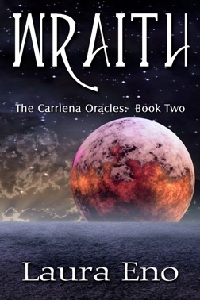
Now, she has a space opera novella called Wraith. It's part of the Carriena Oracles series.  And today is the launch date! Link over to her Amazon author page or her blog to find out more. Here's an intro for Wraith:
Someone wants them dead. Another wants them captured. No one can be trusted. Secrets, lies, and revelations await Raven and Mikael as their search for Mikael's missing friend leads them to Wraith, a mysterious moon owned by Jeffrey Hamilton, cybernetics genius and Ben's creator. How much of the Oracle's technology does Hamilton possess and where did it come from?
Raven's nightmares from the past threaten her sanity, while Mikael's guilt slowly consumes him. Ben's in more danger than anyone as they race to find the answers to uncertain questions—questions which could lead to death for them all.

And while you're out and about, if you haven't already downloaded and read the anthology, The Corner Café: A Tasty Collection of Short Stories, link over and check out this anthology. (Disclaimer: Two of my stories are included in The Corner Café.) To find out more about the authors and the anthology, visit Maryann Miller's blog today.

And, finally, my latest book is Angel Sometimes, the story of a girl who was abandoned to the streets at the age of 12, started swimming at a bar/restaurant as a mermaid at the age of 17, and at 22 goes home to confront the parents who gave her $50 and dropped her 800 miles from home. Her journey from the streets to home makes her strong. The people who stand by her make her family.

You can go to Angel Sometimes' Amazon page to read the book description, as well as read the beginning of the book. To read the sample, just click the arrow above the book cover.

But before you do that, head over to Laura Eno's Author Page. You can see the list of all her books, as well as her latest book, Wraith. It's debuting today! Isn't that a fabulous cover? I love it.

Thursday, June 21, 2012

Cookin' at The Corner Cafe

The Corner Café moves around a lot. Today, it's parked at Alberta Ross' blog. There will be plenty of seating, soft music in the background, and a guest speaker at the microphone while you sip your water or tea. 

Be sure you stick around for the Q&A. Just post your questions in the Comments section.

Thursday, June 07, 2012

Libraries

I came across an article about a panel at BEA 2012. The article was called "BEA2012: What Librarians Wish Publishers Knew". The article, of course, talked about the institutional publishers, but I think it has information for self-published authors, as well.
 … it became very clear during the talk that, with 9,000 library systems across America, libraries are robust places to discover and share books. Of those 9,000 systems, a good thousand have four or more branches. And according to Rawlinson, when libraries survey their public, libraries translate into books. 
Some libraries even have an online system for checking to see  if they have a certain book you may be looking for … and if they don't, the system will help you find the nearest independent bookseller.

Keep in mind, too, that if patrons like a particular book, the library often will buy more copies to keep in stock. And libraries can often do a lot to promote a book they especially like, such as highlighting it on their website.

And, although not mentioned in this article, most libraries now carry e-books.

I think libraries are essential to the public. Many people can't afford to buy even a low-priced book like mine, but they can check out books and e-books from their library.

As a reader, how many books do you check out of your local library? If you're an author, have you managed to get your book in your local library?

Speaking of reading, a short story anthology, The Corner Café, has just come out. Two of my stories are included in it: Gila Monster and One Last Run. All the authors involved are doing a month-long book tour. Drop by and read today's post over at Magic Dog Press. One thing about this book that I think is fabulous is that all royalties go to charity.

Thursday, May 24, 2012

eBooks Without DRM?

DRM stands for Digital Rights Management. If you have an iPad and your beloved has a Nook, DRM is what keeps you from sharing between the two devices. With a print book, you can donate it or lend it to your sister. Currently, you can't do that with ebooks. But times may be changing.
Science fiction publisher Tor, an imprint of Macmillan USA, is making its entire ebook list free of digital rights management (DRM) as of July this year, along with sister imprints Forge, Orb and Starscape.
The article in Forbes claims that the time is overdue to remove DRM because DRM is "a meagre fig leaf of protection against piracy because anyone who really wants to copy a book will find that circumvention is trivially easy." (Course, that "anyone" doesn't include me since I can have trouble turning on my iPad, let alone messing with the inner workings of an eBook or digital device.)

There have been times that I've downloaded and read a book on my iPad that I know my husband would like. But I don't even know how to share it to his iPad.

What do you think of removing DRM from eBooks?

Wednesday, May 23, 2012

Is Self-Publishing a Stigma?

An article in the Huffington Post addresses the question of whether an author is stigmatized when s/he takes the indie route and self-publishes. An unnamed traditionally published author apparently refers to self-publishing as "literary karaoke."

According to the Association of American Publishers (AAP), in 2011 e-book sales rose 117%, generating revenue of $969.9 million, while sales in all trade print segments fell, with mass-market paperbacks plunging by nearly 36%. As a result of this, insiders worry that traditional publishers will focus on hardbacks and publish fewer paperbacks.

The article argues that most readers buy books, not because Simon & Schuster or Berkeley published it, but because they want a good read, be it from a big publisher or from an individual author. They also buy a book based on the cover, the back cover blurb, and the author's name. So indie authors have to make sure they have a professional looking cover and an enticing blurb, as well as a good book. And they have to promote. Promote, promote, promote.

Indie authors can make money, if their product is good, of course:
At $2.99 a pop, authors earn nearly $2.00 on every eBook sale. Even at 99¢, with average royalties of 33¢ to 60¢, earnings on a hot-selling book can quickly out-pace the meager advance offered to all but the superstars by a traditional house. 
I don't think self-publishing has the stigma it used to have. I personally know traditionally published authors who don't consider indie authors to be "real" authors, but with more and more writers going the indie route, I think readers will become their own judges and gatekeepers. They will try new indie authors because the price is low and they will like what they read and then buy more by that author - or they will try someone else. And they will be able to do that without spending $25 for a hardback. For that amount, they could have bought 8 indie books, and hopefully found 8 authors they like. And those authors would have earned more than if they'd been published in hardback by a major house.

Thursday, May 17, 2012

Future of Publishing

I read a really interesting article in The Huffington Post. It was one person's (John B. Thompson) look into the future of publishing.

Here are his 7 trends in the future of publishing:

1. Amazon will continue to grow as a retail channel, while bricks-and-mortar booksellers (including the bookselling chains like Barnes and Noble) will find themselves squeezed further and further, leading to more bookstore closures and downsizing on the part of the chains.

2. … publishers with weak balance sheets and companies that are highly leveraged will face growing financial difficulties … leading to further consolidation in the hands of a small number of large corporations ….

3. … the decline of retail space in bookstores - the shop windows, front-of-store display tables and rows of bookshelves - and the decline of book review space in traditional print media … will make it harder for publishers to get their books noticed, … as publishers are forced to devote more and more of their marketing effort to the online environment ….

4. … income from e-books and other forms of electronic sale will become an increasingly significant part of publishers' revenues, though exactly how significant is, at this point in time, unknown - maybe 20 percent, maybe 30, maybe 50, maybe more, no one knows.

5.  … as more sales shift to digital and the sales of physical books decline, the large publishing houses will face growing downward pressure on their revenues ….

6. … the infrastructure supporting the traditional book supply chain - warehouses, sales forces, etc. - will come under increasing pressure, forcing publishers to scale back their operations ….

7. … small publishing operations and innovative start-ups will proliferate, as the costs and complexities associated with the book supply chain diminish ….

Tell us what you think. Then link over and read the full article.

Wednesday, May 16, 2012

How Fast Can You Write?

The title question was prompted by an article in the Business section of the New York Times. The title of that article by Julie Bosman is: Writer’s Cramp: In the E-Reader Era, a Book a Year Is Slacking. The article says that print authors, because of the e-book age, have to put out two books a year, instead of the expected one. The article says the cause is readers who can go online and click and, voila, a new book arrives in their eReader.

So, now, the best-selling print authors are scrambling to come up with more books or short stories or novellas for their publishers as a way to hold onto readers. Names like Lisa Scottoline, Lee Child, and John Grisham are pushing to get more material out to the reading public.

Jennifer Enderlin, associate publisher of St. Martin's Paperbacks, says "I almost feel sorry for authors these days with how much publishers are asking of them…"

This is probably just me, but…I don't feel all that sorry for them. If unknown authors are putting two or three books out a year -- and they're good -- then why is it such a burden on the highly paid, agent and publisher supported authors?  The problem isn't that it takes a full year because the authors want to put out the best book possible. Independent authors want and do that, as well. Some of them take a year, too.

I think the problem is that now well-known authors have some legitimate and dedicated competition. Writers don't have to jump through agent and publisher hoops, if they don't want to. There are plenty of authors still querying. More power to them! But there are even more who are doing their own publishing. And that's creating a humongous choice for readers. They can still choose to buy an established author's books. But now they have a wider choice of alternatives and prices and formats. So they're reading more and sampling from a bigger smorgasbord of books.

Saturday, April 21, 2012

Self-Publishing

What makes a self-published e-book a success? I think most would say, selling a ton of copies. And while that's true, how do you create a book that sells a ton of copies?

 How about writing a compelling book with interesting characters? That sounds good.

What else?

Let's look at a Canadian author, Shadonna Richards. She couldn't find an agent or publisher, so she decided to follow Amanda Hocking's model and publish on Kindle.

 She hired a professional editor. She started learning how to promote her books. She did her own bookcovers, but worked to make them great. She created a two-line blurb to entice potential readers. And she kept writing.

According to CTV News online, Richards is "now Amazon's #1 Kindle Bestselling Author, with 110,000 downloads to her credit. She's doing so well, she's currently earning about $6,000 a month from her writings."

What are you doing to create a book that will be a success? Share your steps in the comments section.

Thursday, April 19, 2012

Enhanced E-Books

What exactly are enhanced e-books? Well, there are different answers to that question. It would seem to mean that something has been added or improved. But that "something" varies and is developing.

A U.K.-based design firm is taking Frankenstein and making the book interactive. Readers will be able to "brake and steer and maybe look under the hood." Not sure exactly what that will look like.

The YA book, Chopsticks, will allow readers to "flip through a photo album, watch video clips, listen to the favorite songs of the book’s characters, see their instant messages. You even can consume the book in shuffle mode–that’s right, you’re able to change the order of content."

Books are going multi-media with videos. There are even companies making books more "literary Farmville." Readers can vote to flesh out characters and storylines - and get access "to secret chapters if they encourage friends to read the book."

How will this change books? Is it still a book if you are watching videos, altering the characters and story line? If a cookbook recipe takes you ten minutes to read the recipe, but 35 minutes to watch the video, is it more a television show than a book?

Wednesday, April 18, 2012

Lending E-Books

I was reading an article on the Ventura County Star website about the struggles between libraries and publishers over e-books. The Camarillo Library has a collection of over 1,400 digital books. They're treated pretty much like print books. Only one person can check them out at a time and when the loan period ends, the book disappears from the renter's e-device. Then the next person can check it out.

Problem is, the big six publishers are not liking the idea of libraries lending e-books. Four of them refuse to open their e-catalogs to libraries. The other two are charging extra money or limiting lending. At one point, Random House tripled its prices to libraries.
A recent study from the Pew Internet and American Life Project found 28 percent of American adults own a tablet or e-reader, with ownership nearly doubling during the last holiday season. 
 The article noted that libraries are wrestling with how much to spend on e-books since they don't actually own them.
A Kindle owner can buy Jonathan Kellerman's "Victims" for $12.99, for example, but a library must pay $84 to lease access to the same e-book through Overdrive…
 Plus, libraries can't share the e-books among facilities. And they can't accept e-books as donations.

I'm thinking librarians know how many times a print book can be checked out before it is too worn to be kept on the shelves. Why not apply that number to e-books? Say, if the average print books can hold up to 30 readings before it is too damaged to lend anymore, then an e-book can be lent 30 times before it disappears and the library buys a new one.

 What ideas do you have on this?

Wednesday, April 11, 2012

Kindle Sales

 Virtual Strategy Magazine had a recent article about Best-Selling Paid Kindle Books in March. I'm going to highlight some of the article highpoints. In talking about these 16 books, they included "only paid units and do not take into consideration borrowed or free units."

More than 100,000 books are now available in the Kindle Owners’ Lending Library, including over 100 current and former New York Times Best Sellers. 

 In March, each time Kindle owners borrowed a KDP Select book from the lending library, the author received $2.18, leading to significant increases in income for independently-published authors. 

Debora Geary was one of the top 10 KDP Select authors in February, and 51% of customers who borrowed one of her books from the Kindle Owners’ Lending Library went on to buy one of her titles. 

L.J. Sellers, author of the Detective Jackson Mystery/Thriller series, saw that 25% of customers who borrowed one of her books also bought one of her books, all of which are also available in the lending library. 

 T.R. Ragan is the best-selling thriller author of the Lizzy Gardner Series and was the number one KDP Select author in February. She earned over $11,000 from the KDP Select fund, and her royalties from paid sales of her books increased by more than four times from January to February.
Clearly, the article was an endorsement of the KDP Select program. But it also shows that the program has been beneficial for a lot of writers. [Shout out to L.J. --Yay!] If any of you have your books currently available through the Kindle lending library or would like to provide your own stats or just want to leave a comment, please join us in the Comments section.
Related Posts Plugin for WordPress, Blogger...